Saturday, September 21, 2019

08/26/19 - Fort Nelson, British Columbia, Canada

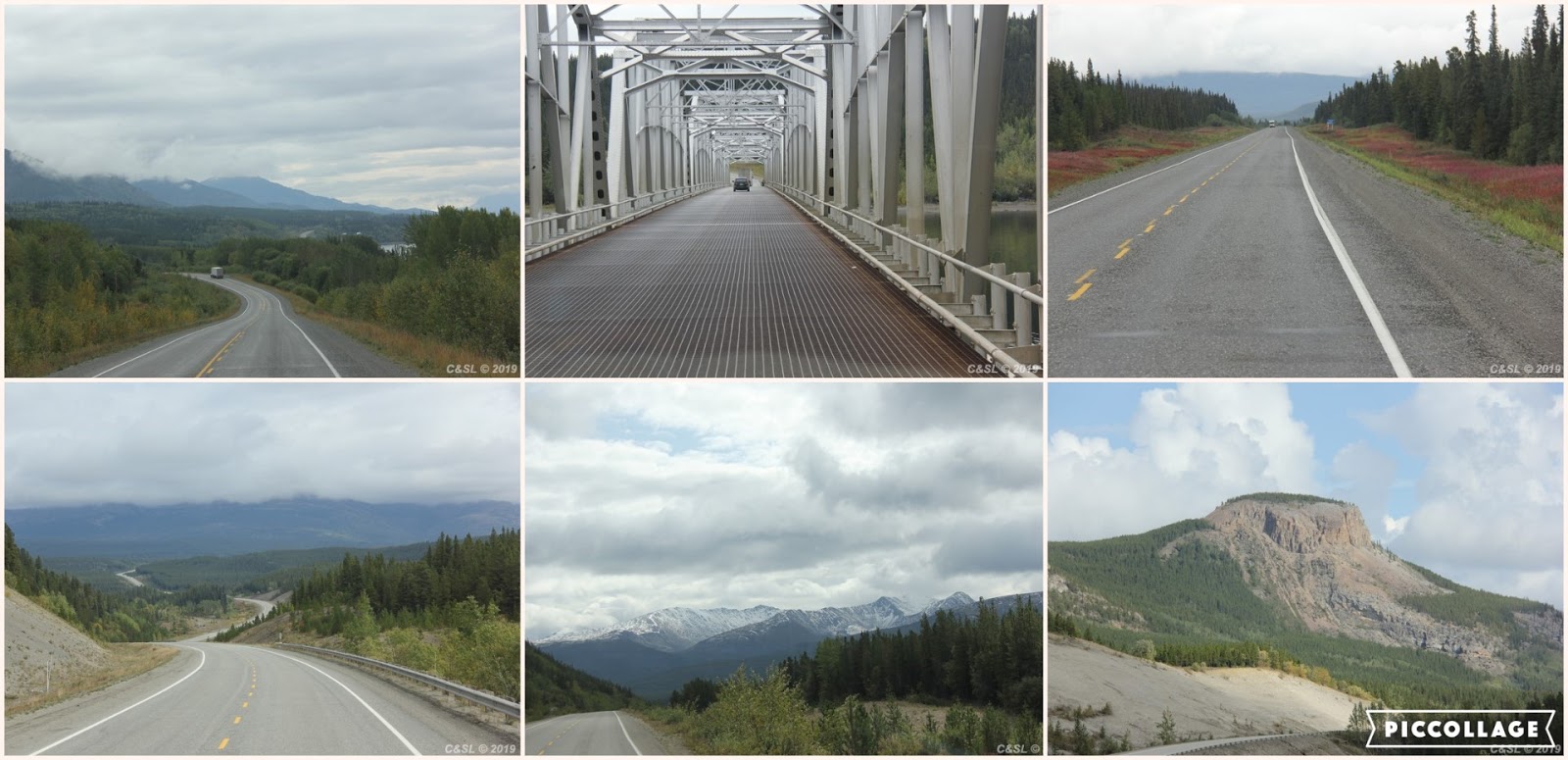
Going from Watson Lake to Fort Nelson, we drove through the Northern Rocky Mountains.  There's some beautiful areas. The highest point on the Alaska highway is Summit Lake at an elevation of 4250 feet above sea level

You can click on the pictures to enlarge them.


We stopped across the highway from Liard River Hot Springs Provincial Park; there is an overflow parking lot. There's a fee booth as soon as you turn off the highway to go to the hot springs and campground. We just wanted to go in and look around, but we found out they charge $5/person for day use, so we didn't. We have seen hot springs before. I don't know if this one has the sulfur smell the other ones have; if they do, I wouldn't want to soak in it. I know it's a very popular place.


Muncho Lake is known for its jade green color which is attributed to the presence of copper oxide leached from the bedrock below.  We stopped at a couple places along the way for pictures. 


One of the ladies at the Watson Lake visitor center said we'd see more animals along the route from Watson Lake to Fort Nelson, than we've seen anywhere. She was right. We saw wood buffalo, caribou, stone sheep and deer along the way today. Missed two bear pictures.


We stopped at the visitor center in Fort Nelson. They have free wifi and a free dump station and water next door.  A little ways from there, we stopped at a turnout at MM 245.3 for the night. What we've seen of British Columbia is that it's very clean and ditches and roads are mowed. There's a lot of litter cans and no garbage.

For more pictures, please click here.

08/25/19 - Watson Lake, Yukon, Canada

Heading on to Watson Lake. Watson Lake was an important point during construction of the Alaska Highway in 1942. The airport was one of the major refueling stops along the Northwest Staging Route.

You can click on the pictures to enlarge them.


Watson Lake Sign Post Forest was started by a homesick GI in 1942. A commanding officer asked him to repair the erect the directional signposts. While completing the job, he added a sign that indicated the direction and mileage to his hometown of Danville, Illinois. Others followed suit. They say there are over 77,000 signs. No, we did not add a sign.


The Watson Lake Visitor Center is right beside the sign post forest inside the Rec Center. There is area information and displays. They gave us a paper showing the services and attractions between Watson Lake and Fort Nelson. She told us that we should see a lot of animals along this way, especially bison.


We stopped at Allen's Lookout for the evening. This is a large gravel parking area.


For more pictures, please click here.


Friday, September 20, 2019

08/24/19 Whitehorse, Yukon, Canada

Leaving Dawson City, we stayed at Fox Lake Burn rest area for the night of the 23rd, and moving on to Whitehorse on the 24th.

You can click on the pictures to enlarge them.


It rained most of the way to Whitehorse and quit after we got there.  We were able to park at the visitor center, but it was a tight squeeze. I went inside for information while Curt unhooked the jeep. From there we went to the S.S. Klondike National Historic Site, a couple of blocks away.

Per the above website, "The S.S. Klondike was built in Whitehorse and launched in 1929. With a cargo capacity 50 percent greater than other boats on the river at that time, she was the first sternwheeler on the Yukon River large enough to handle a cargo in excess of 300 tons without having to push a barge.  Built as an ore hauler the Klondike initially operated between Whitehorse and Stewart Landing. On her downstream run she would carry freight bound for the Mayo silver mining district. On her return trip she would carry silver-lead ore from the Mayo District that had been brought down the Stewart River aboard smaller sternwheelers. The effects of the depression soon saw the Klondike moved to the Whitehorse-Dawson City run where she carried both passengers and freight.

In 1936 the Klondike was in an accident and Klondike II was built and was able to run until 1952, after roads were built and riverboat transportation not needed. She was refurbished as a cruise boat but that only lasted a couple of years. "

They do guided tours for $7.80 (adults), or self-guided tours free. Being it was still raining off and on, the top of the deck was closed, so we wouldn't be able to go up there anyway, we decided to do the self-guided tour of the main deck. 


The Whitehorse Fish Ladder and Hatchery is the largest wooden fish ladder in the world. According to Afar.com, "It help migrating Chinook salmon on the final leg of their epic journey. As young smolts, they migrate downstream to the Bering Sea. After 3-5 years, they re-enter the Yukon River and being the 2-month 3200 km swim back to their home waters. The lucky ones, a tiny percentage, will make it to spawn and die there. This 366 meter (1200 ft) chute allows the salmon to skirt the Whitehorse Dam and avoid its turbines." I only saw two salmon in the inside display area.


Going east on Highway 1, toward Watson Lake. We're going through a cold spell now.


We stopped at a large rest area past Jake's Corner for the night. For more pictures, please click here.