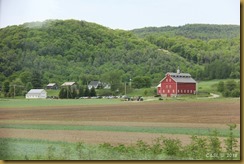
Still hills and trees, but more open areas now. Seeing more dairy farms and farming in general.
Vermont statistics below.
You can click on any of the pictures to enlarge them in a new window.


















Vermont facts from netstate.com
1. Agriculture: Vermont's top five agricultural products are dairy products, beef cattle and calves, greenhouse and nursery products, hay, and maple products. About 3/4 of Vermont's agricultural income is generated by the sale of dairy products. Other important livestock products are beef cattle and calves, chicken eggs, turkeys, and hogs. Honey, farm chickens, and aquaculture is also important to the state. Greenhouse and nursery products lead in this category. Hay, maple products, apples, and sweet corn are other major products. Hay, oats and grain corn are grown to feed Vermont livestock. Leading vegetables grown in the state are sweet corn and potatoes. Apples (official state fruit & pie) are the largest fruit crop. Vermont is a leading maple-syrup producing state and also produces many specialty food products such as cheese, ice cream and sauces. Vermont designated maple as the (official state flavor) in 1994.
2. Manufacturing: The production of electrical equipment (semiconductors, electrical components) is Vermont's most important manufacturing activity. One of the largest electronics companies in the world produces computer components in a large plant near Burlington. Production of food products (dairy products, bakery goods) ranks second in the state followed by manufacture of machinery (machines for making semiconductors and machine tools).
3. Mining: Granite is the most important mined product in Vermont where the largest granite quarries in the country are found. Other mined Vermont products include limestone, marble sand and gravel, slate and talc.
Lots more mountains and trees. More moose signs (no moose).
Maine information below.
You can click on any of the pictures to enlarge them in a new window.






At a Walmart we stopped at, there were 5 campers parked together, a popup-camper parked between two of them set up, some with slides out, jacks down. One had their awning out and they were all standing underneath it. Guess they couldn’t get a camping spot together.















Some New Hampshire facts from netstate.com:
1. Agriculture: New Hampshire's top five agricultural products are greenhouse and nursery products, dairy products, apples, cattle and calves, and sweet corn. Dairy farming and dairy products contribute about 31% of the state's total agricultural receipts. Beef cattle and calves are important along with chicken eggs. Aquaculture and hog production make up a smaller part of the livestock products sector. Greenhouse and nursery products are the most important agricultural products for New Hampshire. Home and garden plants and Christmas trees are the most important items in this area. New Hampshire's most important field crop is hay, used mainly for cattle and horse feed. Maple syrup is an important farm product. Sweet corn and potatoes are the leading vegetable crops while apples are the leading fruit crop.
2. Manufacturing: New Hampshire's leading manufactured products are computer and electronic products. Telephone equipment, computer microchips, military communication systems are also manufactured. Fabricated metals manufacturing (ball bearings, machine tools) is the second-ranking manufacturing activity followed by machinery manufacture (printing, metalworking machinery, lens-making equipment, optical instruments).
3. Mining: Though many important minerals are scattered throughout the state, sand and gravel for roads and concrete are New Hampshire's leading mined products. Granite quarries provide building stones.
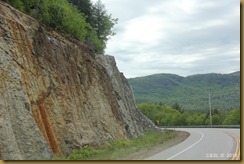
More trees and hills, some farmland, moose crossing signs, but we didn’t see any moose  Some Maine statistics below.
(You can click on any of the pictures to enlarge them in a new window).







 Some Maine statistics from NetState.com:
1. Agriculture: About 60% of Maine's agricultural revenues are derived from livestock and livestock production; 40% from crops. In terms of revenue generated, Maine's top five agricultural products are dairy products, potatoes, chicken eggs, greenhouse and nursery products, and aquaculture products. Eggs and milk are the leading livestock products in the state, followed by chicken eggs. Other important livestock products are aquaculture (Atlantic salmon), cattle and calves, and hogs. Sheep and turkeys are also raised in the Pine Tree State. The state's largest crop is its Maine State Potatoes crop. Other crops are corn, hay, oats and other grains to feed cattle. Greenhouse and nursery products, broccoli, dry beans, peas and other vegetables are also grown. Apples are Maine's most valuable fruit crops, but Maine is also a leading producer of wild blueberries. Other fruit crops are cranberries, raspberries and strawberries.
2. Manufacturing: Leading manufactured products in Maine are paper products, including cardboard boxes, paper bags and pulp, as well as paper. Ranking second in the manufacturing sector is computer and electronic equipment (personal computer microchips, communications equipment). Third is transportation equipment (ship building, repair, some aerospace equipment).
3. Mining: Sand and gravel and limestone are the base products of Maine's mining industry. Other mined products clays, garnet, gemstones (amethyst, topaz, tourmaline), granite and peat. Large copper and zinc deposits have not been fully developed.
4. Fishing: Maine's fish and shellfish industry is ranked high among the states. Its yearly lobster catch is the biggest of any state. Other important products are soft-shell clams, mussels, crabs, and sea urchins. Commercial fish include cod, flounder, haddock and sea herring. Fish farms breed Atlantic salmon.

